
In today’s digital land, businesses depend heavily on technology to operate efficiently and remain competitive. Still, managingIT systems internally is getting more complex, precious, and resource-voracious.
This is why numerous companies are choosing outsourced IT support as a strategic result.
Outsourcing IT support enables businesses to reduce functional costs, gain access to expert-position specialized services, and ameliorate overall performance without maintaining a full in-house IT platoon.
Numerous associations report significant cost savings and bettered effectiveness when shifting to external IT support models.
What Does Outsourcing IT Support Mean?
Outsourcing IT support refers to hiring an external provider to manage a company’s IT structure, systems, and specialized operations.
This generally includes
- Helpdesk and specialized support
- Network and garçon operations
- Cybersecurity monitoring
- Pall structure operation
- Data backup and disaster recovery
Rather than establishing internal brigades, businesses rely on external technical expertise to manage IT operations more effectively.
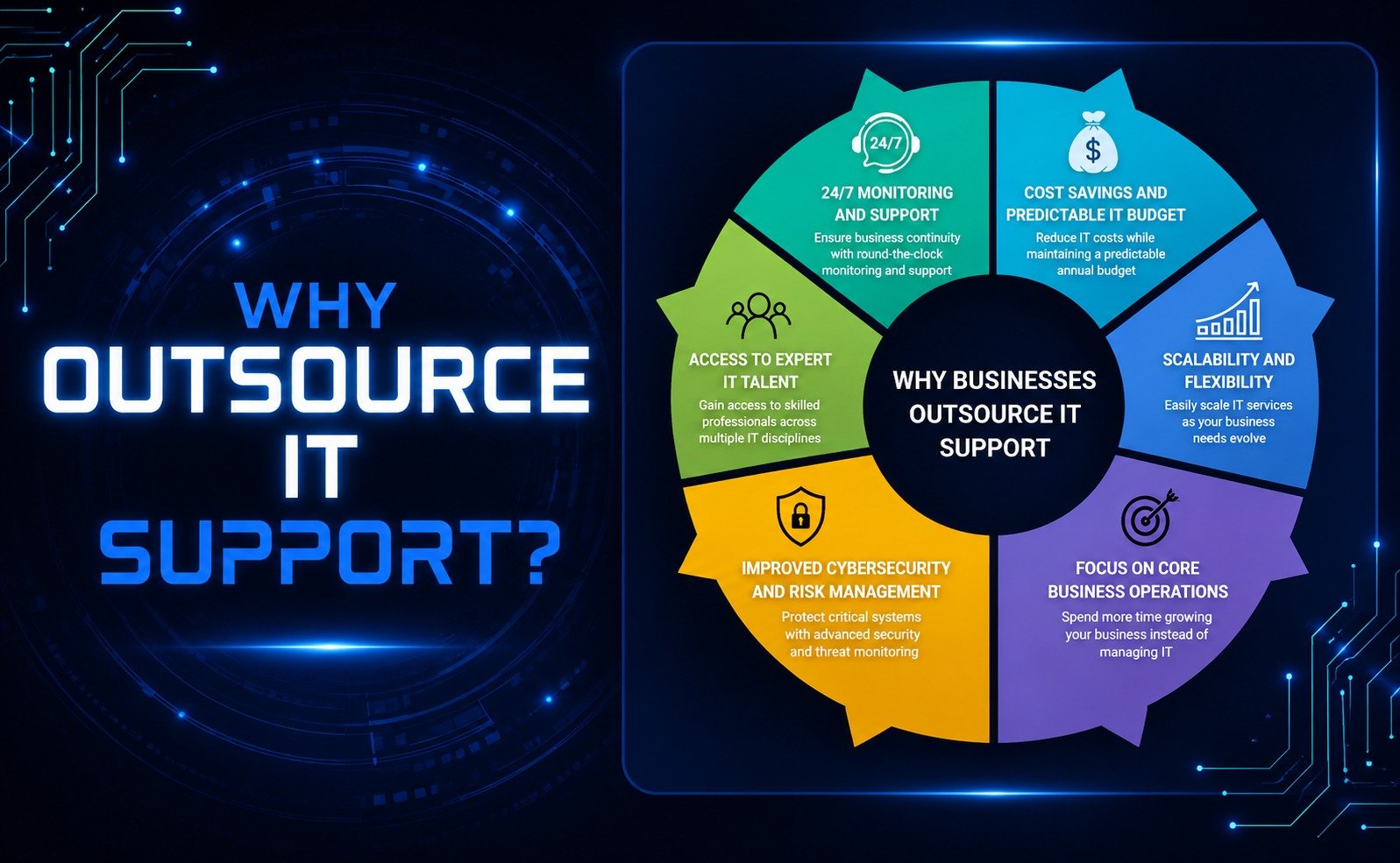
Why Businesses Outsource IT Support
Cost Savings and Predictable IT Budget
Maintaining an in-house IT department involves significant costs, including hires, training, tackle, and software investments.
Outsourcing allows businesses to
- Reduce fixed functional costs
- Convert IT charges into predictable yearly spending
- Avoid large-structure investments
This makes budgeting more effective and scalable.
Access to Expert IT Talent
Outsourcing provides access to a platoon of professionals with technical moxie in multiple areas, including cybersecurity, cloud computing, and network operation.
An internal IT platoon frequently lacks the breadth of knowledge that an external provider can offer.
System time-outs can affect lost profit and reduced productivity.
24/7 Monitoring and Support
System downtime can result in lost revenue and reduced productivity.
Outsourced IT support offers:
- Continuous system monitoring
- Proactive issue detection
- Fast response and resolution
This process ensures business continuity and minimizes disruptions.
Improved Cybersecurity and Risk Management
Cyber threats are increasing in both frequency and complexity.
Outsourced IT providers implement the following:
- Advanced security tools
- Real-time threat monitoring
- Regular system updates and compliance checks
This approach significantly reduces the risk of data breaches and cyberattacks.
Focus on Core Business Operations
Managing IT internally can divert attention from core business activities.
Outsourcing allows companies to:
- Focus on growth and strategy
- Improve operational efficiency
- Enhance customer experience
This leads to better overall business performance.
Scalability and Inflexibility
Business needs change over time, especially during growth phases.
Outsourced IT support enables associations to
- Scale services up or down as demanded
- Snappily acclimatize to new technologies
- Avoid detainments associated with hiring
This inflexibility is essential in a fast-changing digital geography.
| Factor | Outsourced IT Support | In-House IT |
|---|---|---|
| Cost | Lower and predictable | High fixed costs |
| Expertise | Access to multiple specialists | Limited skill set |
| Availability | 24/7 support | Limited working hours |
| Scalability | Highly flexible | Difficult to scale |
| Security | Advanced tools and monitoring | Depends on internal capability |
Who Should Outsource IT Support?
Outsourcing IT support is ideal for
- Small and medium-sized businesses
- Startups passing rapid-fire growth
- Companies without devoted IT moxie
- Businesses taking 24/7 system monitoring
It’s especially salutary for associations seeking enterprise-position IT capabilities without high functional costs.
How Outsourced IT Support Works
Choosing the right IT support provider is critical for success.
A data-driven approach ensures better decision-making by
- Assessing provider performance criteria
- Comparing service capabilities
- Assaying assiduity-specific moxie
This reduces threat and improves issues.
Data-Driven IT Support Outsourcing
Opting for the wrong IT provider can lead to inefficiencies, security pitfalls, and gratuitous costs.
A data-concentrated approach helps businesses
- Access vindicated IT support providers
- Compare performance and service quality
- Identify the best-fit results grounded on specific requirements
This allows associations to make informed opinions rather than counting on hypotheticals.
Common Challenges and How to Avoid Them
While outsourcing offers numerous advantages, businesses should be apprehensive of implicit challenges
- Choosing the wrong provider
- Lack of clear service-position agreements
- Data security concerns
These issues can be minimized by using data perceptivity, clear contracts, and proper seller evaluation.
Future of IT Support Outsourcing
Crucial trends shaping IT outsourcing include
- AI-driven IT monitoring and robotization
- Increased focus on cybersecurity
- Growth of pile-grounded structure support
- Data-driven seller selection processes
Outsourcing is becoming a critical strategy for businesses aiming to stay competitive.
FAQs
Why outsource IT support?
Businesses outsource IT support to reduce costs, access expert talent, improve cybersecurity, and ensure continuous system monitoring without maintaining an internal team.
What are the benefits of outsourcing IT support?
Key benefits include cost savings, improved efficiency, access to expertise, enhanced security, and scalability.
Is outsourcing IT support cost-effective?
Yes, outsourcing typically reduces operational costs compared to maintaining an in-house IT department.
Is outsourced IT support secure?
Yes, most providers offer advanced security measures, continuous monitoring, and compliance support.
Who should outsource IT support?
Small businesses, startups, and growing companies benefit the most from outsourcing IT support.
What services are included in IT outsourcing?
Services include helpdesk support, cloud management, cybersecurity, data backup, and network monitoring.