Introduction
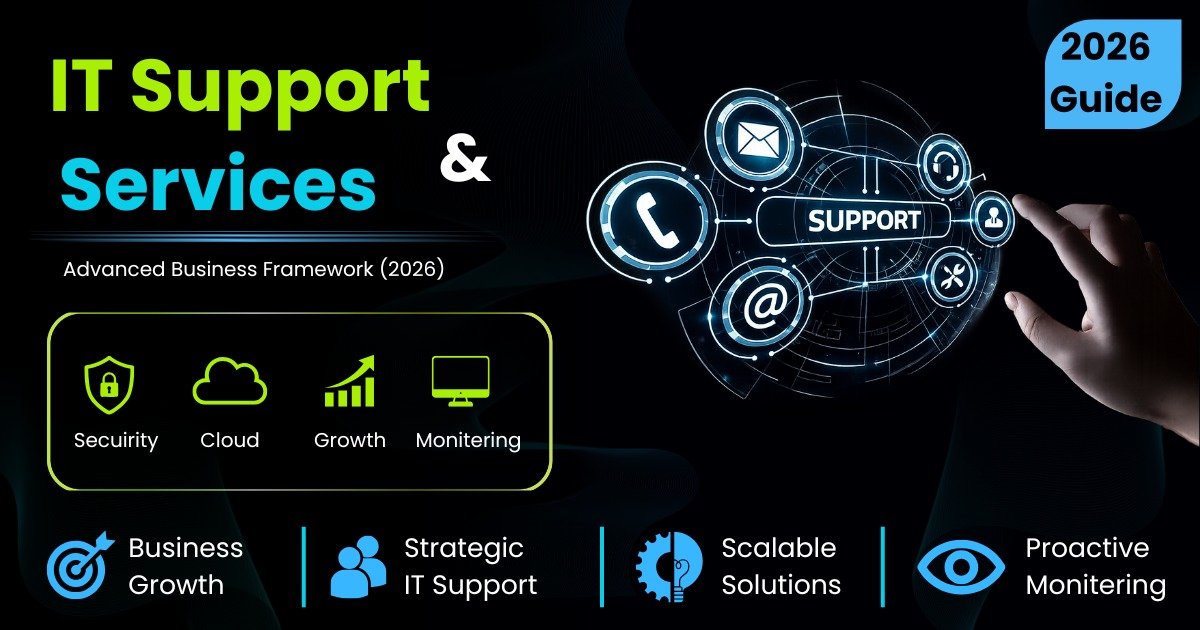
IT support and services are no longer just about fixing technical issues. They are now a critical part of business growth, operational stability, and long-term scalability. Companies that invest in structured IT systems experience fewer disruptions, stronger security, and better performance across all departments.
In a digital-first economy, the difference between growing businesses and struggling ones often comes down to how effectively they manage their IT infrastructure.
What Are IT Support and Services?
IT support and services refer to professional solutions that manage, maintain, secure, and optimize a company’s technology systems, including networks, software, hardware, and data environments.
Architecture of IT Support
Modern IT support operates across three layers:
1. Operational Layer (Execution Level)
This includes:
- Help desk support
- Troubleshooting
- System updates
- Device management
This is what most businesses think IT support is—but it’s only the surface.
2. Control Layer (Monitoring & Stability)
This layer includes:
- Real-time system monitoring
- Network traffic analysis
- Performance tracking
- Alert systems
Here, IT support becomes proactive instead of reactive.
3. Intelligence Layer (Growth & Optimization)
This is where advanced IT support stands out:
- Predictive failure detection
- Resource optimization
- Cost-performance balancing
- Security behavior analysis
This layer transforms IT from a support function into a business growth engine.
The Shift from “Support” to “System Ownership”
Traditional IT support reacts to problems. Modern IT services take ownership of systems.
Old Model
- Fix issues when they happen
- No long-term strategy
- Fragmented systems
New Model (2026)
- Own full IT ecosystem
- Continuous optimization
- Integrated systems approach
Businesses that adopt system ownership:
- Reduce downtime by up to 70%
- Improve operational efficiency
- Lower long-term IT costs
Core Pillars of IT Support and Services
To dominate search rankings, content must go deeper than definitions. These pillars create topical authority.
1. Infrastructure Stability
Infrastructure is the backbone of IT systems.
Includes:
- Servers
- Networks
- Databases
- Cloud systems
Without stability, everything else fails.
2. System Continuity Engineering
This is not just backup—it’s continuous uptime strategy.
Includes:
- Failover systems
- Redundancy planning
- Disaster recovery frameworks
This ensures zero or minimal downtime.
3. Security Integration Layer
Security is no longer separate; it is embedded into every system.
Includes:
- Endpoint protection
- Network security
- Access control systems
- Behavioral monitoring
4. Performance Optimization
Optimization includes the following
- Load balancing
- Resource allocation
- Speed improvements
- System efficiency tuning
This directly impacts productivity and ROI.
5. Automation and Workflow Engineering
Automation reduces manual work and errors.
Examples:
- Automated backups
- Patch management
- Alert systems
- Task scheduling
Automation is a major ranking gap in competitor content.
Types of IT Support Services
Instead of basic types, here is a strategic classification
Reactive Support Services
- Issue resolution
- Emergency fixes
- Incident response
Used when problems occur
Proactive Support Services
- Monitoring systems
- Preventive maintenance
- Performance checks
Prevents problems before they happen.
Predictive IT Support
This is what most competitors don’t cover.
- AI-based monitoring
- Failure prediction
- Data-driven decisions
This is the future of IT support.
Fully Managed IT Ecosystems
This includes:
- End-to-end IT management
- Continuous monitoring
- Security integration
- Cloud management
IT Support as a Revenue Driver (Unique Angle)
Most businesses see IT as a cost. High-performing companies treat it as arevenue driver.
How IT Support Generates Revenue
1. Faster Operations
Systems work efficiently → more output → higher revenue
2. Reduced Downtime
Less downtime = more active business hours
3. Better Customer Experience
Fast systems improve service delivery
4. Data Utilization
IT systems help analyze and use data for growth
IT Support and Services for Small Businesses
Small businesses face unique challenges:
- Limited budget
- Lack of expertise
- High dependency on systems
Strategic IT Support Approach for SMBs
Instead of full systems, they need
- Scalable solutions
- Cost-efficient services
- Flexible support models
Best approach:
- Hybrid IT support
- Partial outsourcing
- Cloud-first systems
IT Support and Cybersecurity Convergence
This is a critical ranking section most competitors miss.
IT support and cybersecurity are no longer separate.
Why They Are Merging
- Cyber threats are increasing
- Systems are interconnected
- Remote work increases risk
Integrated Security Model
- Continuous monitoring
- Threat detection
- Real-time response
The Economics of IT Support
Instead of basic pricing, here’s a deeper breakdown
Cost Factors
- Infrastructure complexity
- Number of users
- Security requirements
- Support level
Cost vs Value Analysis
Cheap IT support:
- Frequent downtime
- Security risks
- Poor performance
High-quality IT support:
- Long-term savings
- Better efficiency
- Higher ROI
IT Support Lifecycle
Most articles don’t explain the lifecycle.
Phase 1: Assessment
- Analyze current systems
- Identify gaps
Phase 2: Implementation
- Setup infrastructure
- Configure systems
Phase 3: Monitoring
- Continuous tracking
- Performance analysis
Phase 4: Optimization
- Improve efficiency
- Reduce costs
Phase 5: Scaling
- Expand systems
- Support growth
IT Support and Digital Transformation
IT support is the backbone of digital transformation.
Without IT Support:
- Systems fail
- Data becomes insecure
- Growth slows down
With IT Support:
- Smooth transformation
- Scalable systems
- Faster innovation
Industries That Require Advanced IT Support

Healthcare
Requires compliance + security
Finance
Needs real-time systems + protection
E-commerce
Requires uptime + speed
SaaS Companies
Need scalable infrastructure
Manufacturing
Requires automation systems
Future of IT Support and Services (2026–2030)
AI-Driven Support Systems
Automated issue resolution
Self-Healing Systems
Systems fix themselves
Hyper Automation
Everything becomes automated
Zero Trust Security
Strict access control systems
Edge Computing Support
Faster processing near users
How to Choose the Right IT Support Provider
1. Look Beyond Pricing
Cheap providers cost more long-term
2. Check Technical Depth
Basic support is not enough
3. Evaluate Response Time
Speed matters
4. Ensure Scalability
Support should grow with business
5. Check Security Integration
Security must be included
Signs You Need IT Support Immediately
- Systems crash frequently
- Slow performance
- Security issues
- Data loss risk
- No internal IT team
Best Practices for IT Support and Services
- Continuous monitoring
- Regular updates
- Strong password policies
- Backup strategies
- Employee awareness training
Learn more about:
- managed IT services for small businesses
- MSP vs MSSP
- IT support services
- Cloud IT solutions
- Cybersecurity services
Conclusion
IT support and services have evolved into a critical business function that directly impacts growth, efficiency, and security. Companies that treat IT as a strategic asset rather than a support function gain a competitive advantage in today’s digital landscape
By investing in modern, proactive, and scalable IT support solutions, businesses can reduce risks, improve performance, and build a strong foundation for long-term success.
FAQs
What are IT support and services?
They are solutions that manage and maintain business technology systems.
Why are IT support services important?
They ensure smooth operations, security, and efficiency.
What types of IT support exist?
Reactive, proactive, predictive, and managed services.
How do IT services improve productivity?
By reducing downtime and automating tasks.
What is the future of IT support?
AI-driven automation and predictive systems.