
Most companies don’t realize they’ve outgrown their IT setup until a breach, a major outage, or a compliance audit forces the conversation. By then, the cost—financial, operational, and reputational—is already compounding.
Here’s the uncomfortable truth: the managed IT services industry has changed dramatically, and most buyers are still using 2019-era criteria to make 2026-era decisions. That gap is expensive.
This guide exists to close it.
Whether you’re a mid-market company evaluating your first MSP relationship or an enterprise renegotiating a contract that’s no longer delivering, what follows is the clearest, most current breakdown of what actually separates a great managed IT service provider from one that costs you more than it saves.
Why Choosing the Wrong Managed IT Service Provider Is a Business Risk, Not Just a Vendor Problem
Let’s reframe the stakes.
Your IT environment is no longer a back-office function. It’s infrastructure for revenue, compliance, customer trust, and operational continuity. When that infrastructure is managed poorly, the downstream effects touch every department.
According to IBM’s 2024 Cost of a Data Breach Report, the average breach cost for US businesses exceeded $9.4 million — and companies with poor vendor oversight consistently ranked among the hardest hit.
The MSP you choose is either a force multiplier or a liability. There’s rarely a middle ground.
If you’re still in the early stages of research, browse the full MSP directory to compare verified providers across service categories and locations before narrowing your shortlist.
Why Traditional MSP Selection Methods No Longer Work
For years, the standard playbook was simple: get three quotes, check certifications, ask for references, pick the lowest reasonable price.
That approach worked in an era when IT support meant patching servers and managing help desk tickets. It doesn’t work now.
What changed:
- AI-driven threat surfaces. Cyberattacks in 2026 are increasingly automated, polymorphic, and AI-assisted. An MSP that doesn’t operate with AI-augmented security monitoring is structurally behind.
- Hybrid work normalization. Distributed workforces demand zero-trust architecture, endpoint management at scale, and cloud-native tooling — not legacy VPN setups dressed up with new branding.
- Compliance complexity. HIPAA, SOC 2, CMMC 2.0, state-level privacy laws — the regulatory landscape has expanded significantly, and non-compliance penalties have followed.
- Cloud fluency as baseline. Multi-cloud environments are the norm, not the exception. An MSP without deep Azure, AWS, and Google Cloud expertise is operating at a disadvantage before the engagement even starts.
The most common mistakes buyers make:
- Selecting on price alone without understanding the true scope of managed services
- Ignoring SLA specifics—”24/7 support” can mean a chatbot and a 4-hour callback window
- Overlooking cultural fit and communication style, which determines day-to-day friction
- Not stress-testing incident response capabilities before signing
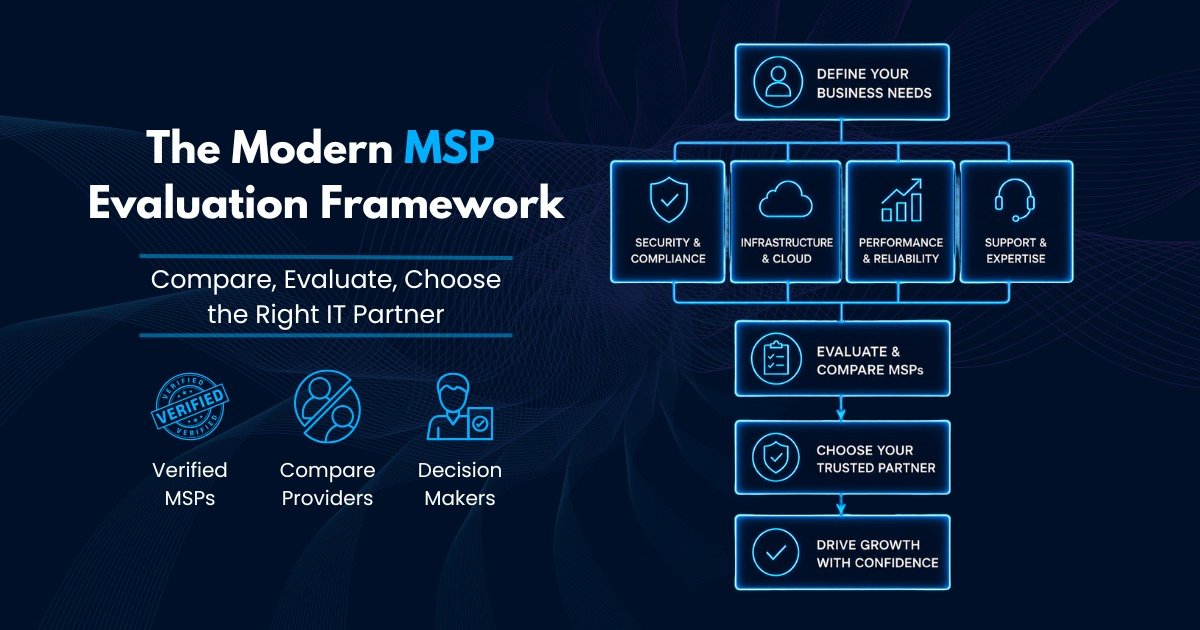
What Actually Works Now: The Modern MSP Evaluation Framework
The best-performing companies approach MSP selection the way they approach any strategic partnership: with a structured, multi-dimensional evaluation framework that weighs capability, culture, and commercial alignment equally.
Here’s the system that works in 2026.
Step-by-Step Framework for Selecting the Best Managed IT Service Provider
Step 1: Define Your IT Maturity Level Before You Talk to Anyone
Before you issue an RFP or take a single demo call, get honest about where your IT environment actually stands.
Businesses in different maturity stages need fundamentally different things. A 40-person professional services firm with no dedicated IT staff needs a full-service MSP that can act as their entire IT department. A 500-person manufacturing company with an internal IT team needs a co-managed model with specialized security and compliance overlays.
Confusing these two scenarios leads to over-purchasing, under-delivering, or both.
Ask yourself:
- Do we have internal IT staff, or is this fully outsourced?
- What are our current security vulnerabilities or compliance gaps?
- What does “success” look like in 12 months?
- Which systems are mission-critical, and what’s our acceptable downtime threshold?
This self-assessment becomes your baseline for every conversation that follows. Once you’ve defined your needs, search for providers by service category to match your maturity stage with the right type of MSP.
Step 2: Evaluate Core Service Tiers — Not Just the Pitch Deck
Every MSP will tell you they offer “comprehensive managed IT services.” The differentiation is in what those services actually include, how they’re delivered, and what’s excluded.
The best managed IT service providers structure their offerings across four capability pillars:
1. Proactive Infrastructure Management
This covers network monitoring, patch management, device lifecycle, and system health. Look for MSPs using AI-driven RMM (Remote Monitoring and Management) tools that identify anomalies before they become incidents — not just after. Infrastructure-focused MSPs typically anchor this pillar with 24/7 NOC coverage and defined escalation paths.
2. Cybersecurity and Compliance
Top-tier MSPs offer layered security stacks: EDR/XDR, SIEM, SOC services, vulnerability management, and compliance reporting. In regulated industries — healthcare, finance, defense contracting — this pillar is non-negotiable.
This is also where the distinction between an MSP and a Managed Security Service Provider (MSSP) becomes commercially relevant. MSSPs specialize exclusively in security — if cybersecurity is your primary gap, a dedicated MSSP may be the sharper fit.
3. Cloud Management and Optimization
This isn’t just “we support Azure.” It means architectural guidance, cost optimization, migration capability, and ongoing governance. Cloud-focused MSPs bring FinOps practices, multi-cloud expertise, and governance frameworks that general IT shops typically lack. Ask specifically about their approach to cloud cost control — runaway cloud spend is a silent budget killer for scaling businesses.
4. Strategic IT Advisory
The best MSPs function as a virtual CIO for companies without one. They align IT strategy to business outcomes — not just keep the lights on. If an MSP can’t speak your business language, they can’t advise your technology roadmap.
Step 3: Interrogate SLAs with surgical precision
Service level agreements are where the real terms live and where most buyers get burned.
“99.9% uptime” sounds impressive. But what does that mean in hours of downtime per year? At 99.9%, that’s roughly 8.7 hours annually. For an e-commerce company processing $50,000 per hour in transactions, that’s nearly half a million dollars in exposure.
Questions that reveal the truth behind an SLA:
- What is your mean time to respond (MTTR) versus mean time to resolve (MTTR)?
- How are SLA violations tracked, and what are the financial remedies?
- What’s excluded from your SLA coverage?
- How do you handle critical incidents outside business hours?
For 24/7 help desk and IT service desk providers, the SLA terms around after-hours response and ticket priority escalation are particularly critical. Get specific. Vague SLAs protect the provider, not you.
Step 4: Assess Security Posture — Not Just Certifications
SOC 2 Type II certification, ISO 27001, and NIST framework alignment are table stakes in 2026. They’re necessary but not sufficient.
The more revealing question is, how does this MSP operate its own security environment?
An MSP that’s been breached—and hasn’t disclosed it proactively—is a material risk. An MSP with strong internal security practices will readily share their own audit results, incident history, and remediation track record.
Key security evaluation criteria:
- Do they operate a 24/7 Security Operations Center (SOC), or do they outsource it?
- What’s their process when a zero-day vulnerability is disclosed?
- Can they provide a sample incident response playbook?
- How do they handle third-party vendor risk within their own supply chain?
The MSPs with the strongest security cultures treat these questions as opportunities to demonstrate competence—not as objections to deflect. If cybersecurity is a primary concern, explore verified MSSP contacts to find providers who specialize exclusively in security operations.
Step 5: Match Provider to Your Geography and Industry
Location matters more than most buyers assume — not because IT support requires physical proximity in the age of remote monitoring, but because local providers understand regional compliance requirements, data residency rules, and industry dynamics in your market.
If your business operates in major metro areas, browse city-specific MSP directories to find providers with demonstrated local expertise:
- Managed IT Service Providers in New York — covering enterprise, financial services, legal, and professional services sectors
- Managed IT Service Providers in New Jersey — strong biotech, pharma, and manufacturing MSP coverage
- Managed IT Service Providers in Chicago — MSP 501 winners and cloud modernization specialists
- Managed IT Service Providers in San Francisco—deep startup, biotech, and high-growth tech company expertise
Local presence also simplifies onboarding, on-site assessments, and hardware deployment — all of which matter during the critical first 90 days of an MSP engagement.
Step 6: Reference Check Like a Venture Capitalist
Most buyers ask for two or three references and conduct polite 15-minute calls. That’s not due diligence.
Talk to at least five references. Prioritize clients in your industry and at your company size. Ask uncomfortable questions:
- Describe the worst incident you experienced during this engagement. How did they handle it?
- Has the service quality changed since the initial onboarding period?
- If you could renegotiate one thing in your contract, what would it be?
- Would you recommend them to a direct competitor?
The answers to those questions will tell you more than any sales pitch.
Common Mistakes That Lead to MSP Regret
Mistake 1: Prioritizing Cost Over Total Value
The cheapest MSP is rarely the most economical choice. One major breach, one extended outage, one failed compliance audit — and the cost delta evaporates instantly. Evaluate the total cost of ownership, not monthly invoice.
Mistake 2: Ignoring Onboarding Rigor
How an MSP onboards you predicts how they’ll manage you. Disorganized onboarding—missed documentation, slow system access provisioning, and unclear escalation paths—is an early indicator of operational immaturity.
Mistake 3: Accepting Vague Escalation Paths
Who do you call when everything is down and the help desk isn’t resolving the issue? If you can’t name a specific person with a specific number, that’s a problem before it becomes a crisis. MSPs offering dedicated 24/7 IT service desk support should be able to walk you through their escalation matrix before you sign.
Mistake 4: Underestimating Cultural Fit
An MSP that communicates in dense technical jargon to a non-technical leadership team will create friction on every engagement. The best MSPs adapt their communication to their audience.
Mistake 5: Not Reviewing Contracts for Exit Clauses
Getting into an MSP relationship is easy. Getting out of a bad one — with your data, documentation, and systems intact—can be extraordinarily difficult without clean exit provisions.
Mistake 6: Overlooking Backup and Disaster Recovery Coverage
This is the mistake that only reveals itself when it’s too late. Many buyers assume backup and DR are included in standard managed IT packages. Often they’re not, or they’re included at a baseline level that doesn’t meet actual recovery time objectives.
Providers specializing in backup solutions and disaster recovery should be evaluated separately on RTO (Recovery Time Objective) and RPO (Recovery Point Objective) commitments — not just whether they “do backups.”
Advanced Strategies for 2026: What the Best MSPs Are Actually Doing
The managed IT services landscape is bifurcating. There are legacy MSPs coasting on long-term contracts and relationship inertia, and there are forward-operating MSPs building genuinely differentiated capabilities.
Here’s what separates the latter.
AI-Augmented Operations
The best MSPs have deployed machine learning across their NOC and SOC operations. This means faster anomaly detection, predictive maintenance modeling, and automated threat response—reducing mean time to resolution dramatically. If an MSP can’t explain how AI is embedded in their operations, they’re likely behind the curve.
Zero Trust Architecture as Standard
Zero trust isn’t a product. It’s an architectural philosophy: never trust, always verify, continuously validate. MSPs operating with mature zero trust frameworks reduce breach surface area significantly—especially in hybrid work environments where the network perimeter has effectively disappeared. Network security-focused MSPs at the enterprise level should have a documented zero trust framework as part of their standard service delivery.
Compliance-as-a-Service
Regulatory compliance is no longer a project. It’s an ongoing operational function. The best MSPs offer continuous compliance monitoring—dashboards, automated evidence collection, audit-ready reporting—rather than annual point-in-time assessments.
vCISO Integration
For companies without a chief information security officer, the best MSPs now offer virtual CISO services—providing strategic security leadership at a fraction of the full-time hire cost. This is particularly valuable for series B-D companies scaling into enterprise sales cycles that require security documentation.
Vendor Ecosystem Management
Your technology stack involves dozens of vendors. The best MSPs manage that ecosystem holistically — handling procurement, renewal optimization, licensing compliance, and integration architecture — so your internal team isn’t context-switching across 40 different portals.
Custom Software and IT Outsourcing
Some MSPs go beyond infrastructure to offer custom software development and IT outsourcing services — building internal tools, automations, and integrations that align your technology stack with your operational workflows. For companies with non-standard processes, this capability can significantly extend the ROI of an MSP relationship.
Practical Checklist: Evaluating a Managed IT Service Provider
Use this before signing any MSP agreement:
- Defined our IT maturity stage and specific service gaps
- Reviewed all four core service pillars in depth (infrastructure, security, cloud, advisory)
- Obtained and stress-tested SLA specifics, including exclusions and financial remedies
- Verified security certifications and reviewed the MSP’s own security posture
- Conducted reference checks with at least five existing clients in similar industries
- Evaluated onboarding documentation and project management methodology
- Confirmed 24/7 escalation paths with named contacts, not generic support queues
- Reviewed contract for exit provisions, data portability, and documentation handover clauses
- Assessed AI and automation maturity within NOC/SOC operations
- Confirmed compliance coverage relevant to our regulatory environment
- Evaluated cultural and communication fit with our internal stakeholders
- Verified backup and disaster recovery SLAs against our actual RTO/RPO requirements
- Matched provider geography to our primary operating locations using the MSP directory
Future Trends Shaping Managed IT Services
AI-Native MSPs Will Emerge as the New Standard
By 2027, the distinction between “AI-enabled” and “AI-native” MSPs will be as meaningful as the distinction between cloud-native and on-premise was in 2018. MSPs building on agentic AI frameworks — where systems self-diagnose, self-remediate, and self-optimize — will outperform reactive service models at scale.
Autonomous Security Operations
AI-powered SOC automation will reduce human analyst intervention for Tier 1 and Tier 2 incidents by 60-70% within three years, according to Gartner projections. This shifts MSP value from headcount to expertise — and rewards MSPs that have invested in AI tooling. Managed Security Service Providers with early AI-SOC investment will be materially ahead of the market within 18 months.
Embedded Compliance Intelligence
As AI regulation — including emerging frameworks around AI system governance — adds new compliance dimensions, the best MSPs will offer embedded compliance intelligence that automatically maps regulatory changes to client environments and triggers remediation workflows.
Consolidation Pressure
The MSP market is consolidating, driven by private equity investment and the operational complexity of maintaining competitive tooling at scale. For buyers, this means vetting acquisition history and ownership structure — because the MSP you sign with today may operate under different management within 18 months.
Outcome-Based Pricing Models
The shift from time-and-materials to outcome-based pricing — where MSPs are compensated against specific business metrics like uptime guarantees, security incident rates, or compliance scores — will accelerate. This aligns incentives far more effectively than legacy per-seat pricing.
Location-Specific MSP Specialization
As regional compliance requirements diverge and industry clusters deepen, MSPs with genuine local expertise will command premium positioning. The New York MSP market, for example, is already differentiating on financial services compliance depth. The San Francisco MSP ecosystem is increasingly bifurcating between startup-focused and enterprise-grade providers.
Conclusion
The managed IT services market is not short on options. It is, however, genuinely short on providers that operate at the level of complexity, security maturity, and strategic alignment that modern US businesses actually require.
The companies that will navigate the next three years most effectively are those that treat their MSP selection as a strategic decision — not a procurement exercise.
Use the framework in this guide. Ask hard questions. Stress-test the SLAs. Talk to real references. Evaluate cultural fit alongside technical capability.
The right managed IT service provider doesn’t just keep your systems running. They give you the infrastructure foundation to grow faster, operate more securely, and compete more confidently.
Start by browsing verified MSPs and MSSPs across service categories and US locations — or narrow your search by geography to find providers with proven local expertise.
That’s the standard worth holding.