
Running a law firm today is not just about legal knowledge. It’s about managing sensitive data, meeting strict compliance requirements, and ensuring your systems never fail when you need them the most.
The reality is simple. Most law firms still rely on outdated systems or reactive IT support. They fix problems after they happen.
That approach no longer works.
With rising cyber threats, remote work, and increasing reliance on digital systems, managed IT services for law firms have become a core part of modern legal operations.
If your systems are not secure, stable, and scalable, your entire practice is at risk.
What Are Managed IT Services for Law Firms?
Managed IT services are a complete, proactive approach to handling your firm’s technology.
Instead of hiring an internal IT team or waiting for issues to arise, you partner with a provider that continuously monitors, manages, and improves your systems.
This includes:
- IT support for law firms
- Cybersecurity for law firms
- Cloud computing for law firms
- IT infrastructure for law firms
- IT compliance for legal firms
The key difference is proactive management. Issues are identified and resolved before they affect your operations.
How Managed IT Services Support Modern Law Firms
Modern law firms rely on digital systems for everything from case management to client communication.
Managed IT services ensure that:
- Your legal case management software runs smoothly
- Your data is securely stored and accessible
- Your systems are always updated and protected
- Your team can work remotely without risk
This creates a stable and secure environment where your legal work is never interrupted by technical issues.
Key Technologies Used in Legal IT Services
To support law firms effectively, managed IT providers use advanced technologies that improve performance and security.
These include:
- Secure cloud platforms for data storage
- Virtual desktop infrastructure (VDI) for remote access
- Endpoint detection and response (EDR) for threat monitoring
- Firewall and intrusion prevention systems
- Legal practice management software
These technologies form the backbone of modern legal IT infrastructure and ensure your systems remain secure and efficient.
Why Law Firms Need Managed IT Services
A law firm is preparing for an important case. Suddenly, their system crashes. Files are inaccessible. Emails stop working.
Everything comes to a halt.
This is exactly what managed IT services are designed to prevent.
With proper IT services for attorneys, you get:
- Continuous system monitoring
- Immediate issue resolution
- Strong data protection
- Reliable system performance
This reduces risks and ensures your firm operates without disruption.
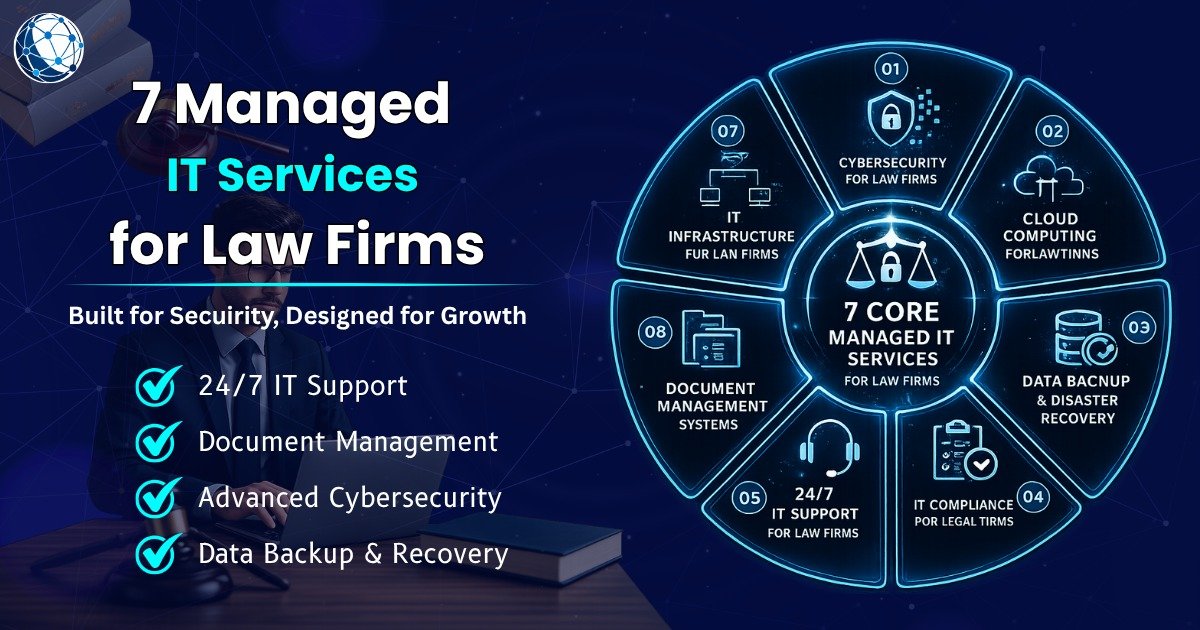
7 Core Managed IT Services Every Law Firm Needs
1. Cybersecurity for Law Firms
Law firms are prime targets for cyberattacks due to the sensitive nature of their data.
Law firm cybersecurity services protect your systems through:
- Real-time threat detection
- Data encryption
- Secure email systems
- Endpoint protection
This ensures that your client information remains protected at all times.
2. Cloud Computing for Law Firms
Cloud technology allows law firms to work more flexibly and efficiently.
With cloud computing for law firms, you can:
- Access files from any location
- Collaborate securely with your team
- Reduce reliance on physical infrastructure
Cloud systems also support digital transformation in law firms by improving accessibility and scalability.
3. Data Backup and Disaster Recovery
Data loss can occur due to human error, hardware failure, or cyberattacks.
Law firm data backup and disaster recovery ensures that your data is always protected and can be restored quickly.
| Feature | Benefit |
|---|---|
| Automated backups | Reduces human error |
| Secure storage | Protects against breaches |
| Fast recovery | Minimizes downtime |
4. IT Compliance for Legal Firms
Law firms must follow strict regulations regarding data protection and privacy.
IT compliance for legal firms ensures:
- Secure handling of client data
- Compliance with legal standards
- Readiness for audits
This includes implementing systems that align with regulatory requirements and best practices.
5. 24/7 IT Support for Law Firms
Technical issues can occur at any time.
With 24/7 IT support for law firms, your systems are continuously monitored and supported.
This ensures that problems are resolved quickly, often before they impact your operations.
6. Document Management Systems for Law Firms
Law firms handle a large volume of documents daily.
Document management systems for law firms help you:
- Organize files efficiently
- Retrieve documents quickly
- Maintain data security
This improves productivity and reduces errors.
7. IT Infrastructure for Law Firms
Your IT infrastructure is the foundation of your operations.
A strong IT infrastructure for law firms includes:
- Reliable networks
- Secure servers
- Integrated software systems
This ensures your firm can operate smoothly and scale as needed.
Managed IT Services vs Traditional IT Support
Many law firms still rely on traditional IT support, which only responds when problems occur.
Managed IT services take a different approach.
| Feature | Traditional IT Support | Managed IT Services |
|---|---|---|
| Approach | Reactive | Proactive |
| Monitoring | Limited | Continuous |
| Security | Basic | Advanced |
| Scalability | Limited | High |
This proactive approach significantly improves system reliability and security.
How Managed IT Services Improve Security
Security is one of the biggest concerns for law firms.
Managed IT providers use layered security strategies, including:
- Continuous monitoring
- Threat detection systems
- Regular updates and patches
- Network security controls
These measures reduce the risk of cyberattacks and protect your firm’s data.
Protecting Client Confidentiality
Client confidentiality is critical in legal practice.
Managed IT services ensure that:
- Data is encrypted
- Access is controlled
- Communication is secure
This creates a secure legal data system that protects sensitive information and builds client trust.
Use Cases of Managed IT in Law Firms
Managed IT services support various functions within a law firm, including:
- Case file management
- Secure client communication
- Remote work solutions for law firms
- Data backup and recovery
- Compliance management
These use cases show how IT services directly support daily legal operations.
IT Solutions for Different Types of Law Firms
Different law firms have different needs.
- Corporate law firms focus on data security and compliance
- Criminal law firms require fast access to case files
- Family law firms prioritize confidentiality and secure communication
Managed IT services can be tailored to meet these specific requirements.
Do Small Law Firms Need Managed IT Services?
Yes, and often more urgently than larger firms.
Small law firms typically have limited IT resources, making them more vulnerable to risks.
Managed IT services provide them with:
- Access to expert support
- Improved security
- Scalable solutions
This allows them to compete effectively without building an internal IT team.
Benefits of Outsourcing IT Support for Law Firms
Outsourcing IT services offers several advantages.
With outsourced IT support for law firms, you can:
- Reduce operational burden
- Access specialized expertise
- Improve system performance
- Focus on legal work
This approach allows your firm to operate more efficiently while maintaining strong IT systems.
Best Cybersecurity Solutions for Law Firms
Modern law firms rely on advanced security solutions, including:
- Multi-factor authentication
- AI-based threat detection
- Managed security services for legal industry
- Secure cloud environments
These solutions protect your firm from evolving cyber threats.
How to Choose the Right Managed Service Provider
Choosing the right provider is critical.
Look for:
- Experience in the legal industry
- Strong focus on security and compliance
- Scalable service offerings
- Reliable support availability
A provider that understands legal workflows can deliver better results.
Conclusion
Technology is no longer a secondary function in law firms. It is a core part of how your practice operates.
Without the right systems in place, your firm faces risks such as data breaches, downtime, and compliance issues.
With the right managed IT services for law firms, you gain:
- Strong security
- Reliable performance
- Scalable growth