
You hired someone to manage your IT. Your systems run fine, and updates happen on time.
Helpdesk picks up when something breaks. So why did a competitor in your industry just
lose $3 million to a ransomware attack with the same setup?
Because managed IT and managed security are not the same thing. Most businesses find
this out too late.
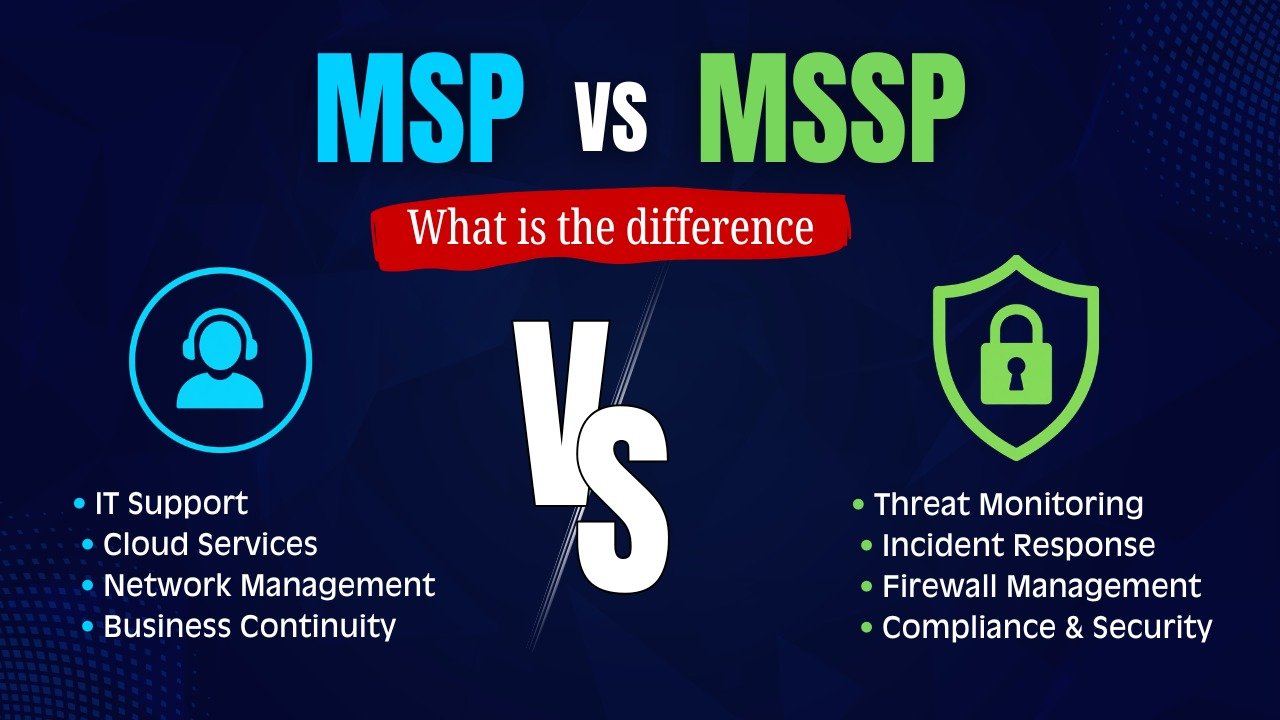
An MSP is your outsourced IT team. An MSSP protects you from cyber threats. One
letter separates the two, but the gap in what they actually do is important. This guide breaks
down the real differences, what each provider costs, which one your business actually
needs, and whether using both makes sense.
What is MSP vs MSSP?
An MSP manages IT infrastructure, devices, networks, cloud systems, and technical support, while an MSSP specializes in cybersecurity services such as threat monitoring, incident response, compliance management, SIEM, and endpoint protection.
MSP vs MSSP Comparison
| Feature | MSP | MSSP |
|---|---|---|
| Focus | IT operations | Cybersecurity |
| Goal | Performance & uptime | Threat prevention |
| Services | IT support, cloud, network | Monitoring, detection, response |
| Security Level | Basic | Advanced |
| Best For | Growing businesses | Security-critical businesses |
What is an MSP (Managed Service Provider)?
A Managed Service Provider (MSP) is an outsourced IT partner that manages and supports a company’s day-to-day technology infrastructure.
Businesses use MSPs to:
- Reduce IT costs
- Improve system uptime
- Outsource technical support
- Manage cloud systems
- Maintain business continuity
MSPs typically operate through a NOC (Network Operations Center), where they remotely monitor systems, networks, devices, and applications.
Their primary goal is operational efficiency and IT reliability.
What is an MSSP (Managed Security Service Provider)?
A Managed Security Service Provider (MSSP) is a cybersecurity-focused company that protects businesses against cyber threats, ransomware, data breaches, and compliance risks.
Unlike MSPs, MSSPs specialize entirely in security.
Most MSSPs operate through a SOC (Security Operations Center), where cybersecurity analysts monitor threats 24/7.
Their services are designed to:
- Reduce business risk
- Detect cyber threats
- Respond to attacks
- Protect sensitive data
- Maintain compliance
Services Offered by MSPs
Common MSP Services
- IT consulting
- Network monitoring and maintenance
- Helpdesk support
- Cloud management
- Backup and disaster recovery
- Patch management
- Device management
- Microsoft 365 administration
- Vendor management
- Device management
- Microsoft 365 administration
Services Offered by MSSPs
Common MSSP Services
- 24/7 threat monitoring
- SIEM management
- Endpoint Detection and Response (EDR)
- Vulnerability assessments
- Firewall management
- Incident response
- Threat intelligence
- Security audits
- Compliance management
- Penetration testing
What Are the Key Differences Between MSP and MSSP?
The easiest way to understand the difference is this: MSPs keep your technology working.
MSSPs keep your technology safe. Both matter, but they solve very different problems.
| Factor | MSP | MSSP |
|---|---|---|
| Primary Focus | IT operations and infrastructure management | Cybersecurity and threat protection |
| Operates From | NOC (Network Operations Center) | SOC (Security Operations Center) |
| Core Goal | Keep systems running efficiently | Protect systems from cyber threats |
| Security Depth | Basic security services such as antivirus, firewalls, and patching | Advanced security operations including SIEM, EDR, MDR, and threat hunting |
| Monitoring | System uptime, performance, and network monitoring | 24/7 threat detection and security event monitoring |
| Incident Response | IT troubleshooting and operational recovery | Security containment, investigation, and digital forensics |
| Compliance Support | Limited compliance assistance | Advanced compliance support for HIPAA, PCI-DSS, GDPR, and other standards |
| Tools Used | Remote Monitoring and Management (RMM) tools | SIEM, EDR, SOAR, MDR, and advanced security platforms |
| Team Expertise | General IT administrators and support technicians | Cybersecurity analysts and threat response specialists |
| Best For | Businesses needing outsourced IT management | Businesses requiring advanced cybersecurity protection |
| Typical Pricing | $100–$250 per user/month | $2,000–$25,000 per month depending on services |
| Main Benefit | Improved IT reliability and operational efficiency | Reduced cybersecurity risk and stronger data protection |
Focus Area
An MSP manages your day-to-day IT environment: networks, devices, users, and
applications. An MSSP manages your security posture. One keeps the lights on. The other
makes sure no one breaks in.
How They Handle Threats
When something goes wrong, an MSP fixes the IT problem: a crashed server, a lost file, a
broken application. An MSSP investigates the security incident: who got in, what they
accessed, and how to stop it from happening again.
Tools They Use
MSPs use remote monitoring and management tools to track system health. MSSPs use
SIEM, EDR, and SOAR platforms to detect and respond to threats. The toolsets are built for
completely different jobs.
Compliance
MSPs can help you stay organized, but compliance is not their core strength. MSSPs are
built for it. If your business falls under HIPAA, PCI-DSS, or GDPR, an MSSP gives you the
monitoring, documentation, and reporting you need to stay audit-ready
MSP vs MSSP Cost Comparison
Cost is one of the biggest factors businesses consider when choosing between an MSP and
an MSSP. The two differ not just in price but in how they charge and what you get for that
price.
MSPs charge per user or per device on a monthly basis. Basic plans start around $100 to
$150 per user per month. More comprehensive packages that include cloud management,
backup, and helpdesk support can range from $150 to $250 per user per month. For a small
business with 20 users, that puts the monthly bill somewhere between $2,000 and $5,000.
MSSP pricing runs higher because of the specialized tools and 24/7 staffing involved. Most
MSSPs charge between $2,000 and $25,000 per month, depending on the size of the
business and the scope of services. Per-endpoint pricing starts around $45 per month for
basic monitoring and can go up to $200 per endpoint for advanced threat detection and
incident response.
That said, the cost of not having an MSSP can far exceed the cost of hiring one. According
to IBM’s 2026 Cost of a Data Breach Report, the average data breach costs businesses
$4.44 million globally. For small and mid-sized businesses, that number still averages $3.31
million. A monthly MSSP contract is a fraction of what a single breach can cost.
Both MSPs and MSSPs offer tiered pricing, so businesses can start with a base package
and scale up as their needs grow. Some providers also offer bundled MSP and MSSP
services, which can reduce overall costs compared to hiring two separate vendors.
Pros and Cons of MSP and MSSP
Every provider has strengths and limitations. Knowing both helps you make a smarter
decision.
MSP: Pros
● Lower monthly cost compared to an MSSP
● Covers all IT needs under one contract
● Ideal for businesses without an internal IT team
● Predictable pricing makes budgeting easier
● Scales with your business as you grow
MSP: Cons
● Not built for advanced cybersecurity threats
● Security coverage is basic and reactive
● Cannot replace a dedicated security team
● May lack compliance expertise for regulated industries
MSSP: Pros
● 24/7 threat monitoring and incident response
● Deep compliance support for HIPAA, PCI-DSS, GDPR
● Reduces risk of costly data breaches
● Access to enterprise-grade security tools without building in-house
● Handles complex threats that MSPs cannot
MSSP: Cons
● Higher monthly cost than an MSP
● Focused only on security, not general IT operations
● May require a separate MSP for day-to-day IT needs
● Can be overkill for very small businesses with low risk exposure
Can You Use an MSP and MSSP Together?
Yes, and for many businesses, using both is the better option. An MSP handles your IT
infrastructure while an MSSP protects it. The two services work well together and don’t
overlap.
Think of it this way. Your MSP makes sure your network runs, your devices are updated, and
your team gets helpdesk support. Your MSSP watches for threats, responds to incidents,
and keeps you compliant. One manages your technology. The other defends it.
This combined method works well for mid-sized businesses that have outgrown basic IT
support but do not yet have a full in-house security team. Some providers offer both MSP
and MSSP services under one contract, which simplifies billing and improves coordination
between IT and security teams.
.
How to Choose the Right Provider?
Choosing between an MSP and an MSSP does not have to be complicated. It comes down
to four honest questions about your business.
What does your business actually need right now?
If your biggest pain point is slow systems, IT downtime, or a team that struggles with basic
tech support, start with an MSP. If you have had a security scare, handle sensitive customer
data, or operate in a regulated industry, an MSSP is the priority
What industry are you in?
Healthcare, finance, legal, and government sectors face strict compliance requirements that
an MSP simply cannot fulfill. An MSSP is not optional for these businesses; it is a regulatory
requirement.
Do you already have an IT team?
If yes, you likely need an MSSP to add a security layer on top of existing operations. If no,
an MSP builds that foundation first.
How do you evaluate the provider itself?
Not every MSP or MSSP delivers the same quality. Before signing a contract, check for
certifications like ISO 27001 or SOC 2 Type II, ask for references from businesses in your
industry, and review their SLAs carefully. Response time guarantees, escalation procedures,
and contract flexibility matter as much as the services listed.
MSP vs MSSP vs MDR vs SOC
As cybersecurity threats become more advanced, businesses are hearing more terms like MSP, MSSP, MDR, and SOC. While these services are connected, they serve very different purposes in modern IT and cybersecurity environments.
Understanding how they differ helps businesses choose the right level of IT management and security protection.
| Service | Primary Role | Main Focus |
|---|---|---|
| MSP | IT management and support | Infrastructure, uptime, helpdesk, cloud systems |
| MSSP | Managed cybersecurity services | Threat monitoring, compliance, security management |
| MDR | Managed Detection and Response | Threat detection and active incident response |
| SOC | Security Operations Center | Centralized cybersecurity monitoring and analysis |
Conclusion
MSPs and MSSPs serve different but equally important roles. An MSP keeps your
technology running. An MSSP keeps it secure. Which one you need depends on your
business size, your industry, the data you handle, and your risk tolerance. Many businesses
get benefits from using both. The cost of getting this decision wrong is not just a higher IT
bill; it is the risk of a breach that could cost millions and take years to recover from. Take
stock of where your business stands today and choose the provider that matches where you
are headed.
FAQs
What is the difference between MSP and MSSP?
An MSP manages IT infrastructure and technical support, while an MSSP specializes in cybersecurity services such as threat monitoring, incident response, and compliance management.
Is MSSP more expensive than MSP?
Yes. MSPs typically charge $100 to $250 per user per month. MSSPs range from $2,000 to
$25,000 per month depending on business size and services. The higher cost reflects 24/7
SOC staffing, advanced security tools, and compliance support.
Can an MSP provide cybersecurity like an MSSP?
Not at the same level. MSPs offer basic security such as antivirus, firewalls, and patch
management. MSSPs deliver advanced threat detection, SIEM, EDR, incident response, and
compliance monitoring. The depth and specialization are fundamentally different.
What industries need an MSSP the most?
Healthcare, finance, legal, government, and e-commerce are the highest-priority industries.
These sectors handle sensitive data, face strict regulations like HIPAA and PCI-DSS, and
are frequent targets for cyberattacks.
Can you use an MSP and MSSP at the same time?
Yes, and many businesses do. An MSP handles day-to-day IT operations while an MSSP
manages cybersecurity. The two services complement each other without overlap when
roles are clearly defined.
Do small businesses need an MSSP?
Small businesses that handle sensitive customer data or face compliance requirements can benefit significantly from an MSSP.
Can a company use both an MSP and MSSP?
Yes. Many businesses use both providers together to manage IT operations and cybersecurity separately.