
MSP lead generation is one of those topics every managed service provider says they understand but few actually do well. And that gap is costing firms serious money.
The managed IT services industry has never been more competitive. More than 40,000 MSPs operate in North America alone, and more arrive every year as experienced IT professionals leave corporate jobs to hang their own shingle. The days when a handful of referrals and a decent reputation in your zip code were enough to keep the lights on are mostly gone. They still matter, but they’re not a growth strategy anymore.
What makes MSP lead generation genuinely difficult isn’t the tactics themselves. It’s the nature of what you’re selling. Managed IT services aren’t impulse purchases. You’re asking a business owner to hand over the keys to their entire technology infrastructure and pay you every month to manage it. That decision requires trust, and trust takes time to build. Most MSP sales cycles run 60 to 180 days. You’re not selling software licenses; you’re selling a relationship.
The firms that are growing consistently right now don’t leave that process to chance. They’ve built systems that put them in front of the right buyers at the right moment, earn credibility before anyone picks up the phone, and move prospects steadily toward a signed agreement. This guide walks through exactly how they do it.
What Is MSP Lead Generation?
MSP lead generation is the process of identifying, attracting, and converting businesses into qualified sales opportunities for managed IT services. It spans everything from ranking on Google for “IT support company near me” to a LinkedIn message to a CFO at a 40-person law firm to a referral from a CPA you’ve built a relationship with over the past year.
The marketing side creates visibility and pulls prospects in. The sales side qualifies them and moves them forward. Both sides have to work, and they have to work together.
Here’s something worth saying plainly: qualified MSP leads are far more valuable than raw lead volume. A pipeline with 50 unverified contacts is mostly noise. A pipeline with 12 verified decision-makers who have a real IT problem, a budget to address it, and a timeline for making a decision is a revenue quarter. Volume feels like progress; quality actually produces it.
An MSP in Chicago we spoke with learned this firsthand. They’d been generating 30 to 40 leads a month through a broad Google Ads campaign and wondering why their close rate was abysmal. When they narrowed their focus to dental practices specifically, creating a landing page titled “Managed IT Services for Dental Offices” and publishing content around HIPAA compliance for practice management software, their total lead volume dropped to 14 discovery calls over 90 days. Every single one was a practice owner with a genuine compliance concern. They closed six new clients that quarter, more than they’d closed in the previous two combined.
That’s what targeted MSP lead generation looks like when it’s working.
Why MSP Lead Generation Matters More Than Ever
The case for building a real lead generation program isn’t complicated, but it’s worth making explicitly because so many MSP owners push it down the priority list until something goes wrong.
MSPs lose between 5% and 15% of their client base every year through natural attrition. Clients get acquired, go out of business, cut costs, or get poached by a competitor with a slicker pitch. That churn is largely outside your control. Without a steady stream of new opportunities coming in, that attrition is a slow bleed that eventually becomes a crisis.
MSPs that depend entirely on referrals for new business tend to experience exactly this pattern: a great quarter when two satisfied clients each send someone their way, followed by a frustrating stretch where nothing happens and revenue flatlines. The phone either rings or it doesn’t, and there’s nothing to do about it either way. That’s not a business model; it’s a lottery.
There’s a competitive reality here too. When a business owner in your market starts searching for “managed IT services” or “IT support for law firms,” they’re going to find someone. Whether they find you or one of your competitors is entirely a function of how visible and credible you’ve made yourself online. Most decision-makers complete 60 to 70 percent of their buying journey before they contact a vendor. Your website, your content, your Google reviews, and your social presence are actively selling (or failing to sell) before your team ever speaks to a prospect.
Building a real MSP lead generation system turns that from a threat into an advantage.
How MSPs Get Clients in 2026
The channel mix has shifted. A few years ago, you could build a decent pipeline with referrals, a basic website, and a few vendor relationships. That’s still part of the picture, but the most effective MSPs are running multi-channel programs that combine inbound and outbound in a way that compounds over time.
MSPs primarily acquire clients through organic search (SEO), Google Business Profile optimization, LinkedIn prospecting, cold email outreach, Google Ads and LinkedIn Ads, referral programs, strategic partnerships with accountants and attorneys, webinars, and in-person networking. The distinction between the firms growing 20% year over year and the ones sitting flat is almost always that the growing ones are using five or six of those channels simultaneously rather than depending on one.
Content marketing and SEO have become particularly important because of how buyer behavior has changed. Business owners research vendors independently before they want to talk to anyone. A well-optimized website with relevant content is a 24/7 sales channel that works whether your team is in the office or not.
The smart approach is to map your channels against what they do best: SEO and Google Ads capture demand from buyers who are actively searching; LinkedIn and cold email generate demand from buyers who aren’t searching yet but should be talking to you; referrals and partnerships deliver high-trust introductions that close faster than anything else.
Best MSP Lead Generation Strategies
SEO for MSPs
When someone types “managed IT services Dallas” or “cybersecurity support for healthcare companies” into Google, they already know they have a problem and they’re looking for someone to solve it. Ranking on page one for those searches puts your MSP in front of buyers at the highest possible moment of intent, and it does it without a per-click cost once you’ve earned those rankings.
SEO for MSPs requires getting the keyword strategy right. There are three layers worth targeting: service keywords like “managed IT services [city],” industry-specific keywords like “managed IT for accounting firms,” and problem-based keywords like “how to prevent ransomware attacks for small businesses.” Service keywords drive the most direct commercial intent. Industry keywords attract the best-qualified prospects. Problem keywords capture buyers early in the research process and build authority with people who’ll eventually need your services.
Tools like Ahrefs and SEMrush are genuinely worth the investment here. They let you see exactly what keywords your competitors are ranking for, where the gaps are, and which opportunities are realistic for your domain’s current authority. A slow, technically broken website won’t rank no matter how good the content is, so technical health matters just as much as what you publish.
Run a keyword gap analysis, identify the 10 highest-value terms your top competitors rank for that you don’t, and build dedicated pages for each one. That single exercise has driven meaningful organic growth for dozens of MSPs.
Local SEO
Most MSP client relationships are geographically limited. Clients want a partner who can send a technician when something breaks. That reality makes local search visibility not just important but arguably the highest-priority SEO focus for most MSPs.
Local SEO comes down to three things: your Google Business Profile (which we’ll cover next), consistent NAP citations across directories like Yelp, Clutch, and IT-specific platforms, and locally relevant website content. City-specific service pages are particularly valuable. “Managed IT Services in [City]” pages, built with genuine local context and not just a city name dropped into a generic template, rank well and convert well because they’re exactly what the searcher was looking for.
If you serve multiple metro areas, build a page for each one. It’s one of the highest-ROI activities in MSP marketing and most competitors haven’t bothered to do it properly.
Google Business Profile
Honestly, Google Business Profile is the most underleveraged tool in most MSPs’ marketing stack. A fully optimized listing drives local search visibility and phone calls with zero ad spend, and most MSP listings are half-completed at best.
Fill in everything: service descriptions, all relevant business categories (start with “Computer Support and Services”), service area maps, photos of your office and team, and a consistent posting schedule through Google Posts. The piece that makes the biggest difference is reviews. Google weighs review quantity and recency heavily in local map pack rankings. Five genuine reviews from real clients beats a perfect listing with no social proof every time.
An actively managed Google Business Profile is often the difference between showing up in the local map pack and being invisible to every buyer in your market who searches on Google. That’s not hyperbole; it’s what the data shows.
Start this week: audit your listing, complete anything missing, add photos, publish a post, and send review requests to five clients you know are happy with your service.
LinkedIn Prospecting
This is the only channel where you can reach the CFO of a 35-person accounting firm, the operations director of a regional law practice, and the owner of a dental group all in the same afternoon. LinkedIn Sales Navigator lets you filter by company size, industry, job title, geography, and even technology stack. The targeting precision is unmatched for B2B outreach.
The MSPs getting results on LinkedIn aren’t spray-and-pray connecting with everyone in their city. They’re doing real research before reaching out, looking at what the prospect has posted about, what their company has recently gone through, and what pain points their industry is publicly dealing with. A connection request that references something specific about the prospect’s situation gets accepted and responded to at a dramatically higher rate than a generic “I’d like to connect.”
Build a list of 50 target companies this week, identify the right decision-maker at each, and run a 30-day personalized outreach sequence. Track what gets responses and refine from there.
Cold Email Outreach
Cold email still works. It works less well than it did five years ago, and it works a lot worse than it does for MSPs who are doing it wrong. The difference is specificity.
The MSPs generating real meetings from cold email in 2026 are sending tightly targeted sequences to defined audiences with messaging that speaks directly to a pain point that audience actually has. Not “we provide managed IT services for businesses of all sizes.” Something like: “Accounting firms are the second-most targeted industry for ransomware attacks this year, and most are running on network configurations that would fail a basic security audit. We’ve helped three firms in [city] fix that before they found out the hard way.”
That message works because it’s specific, it’s relevant to the recipient’s situation, and it suggests the sender actually knows something about their world.
Deliverability is half the battle. Warm your sending domain before scaling volume, keep your lists clean, and don’t exceed safe daily sending limits or you’ll damage your sender reputation in ways that take months to fix. A tool like Apollo.io or ZoomInfo gives you the contact data; your messaging determines whether the campaign produces meetings or silence.
Referral Marketing
Referral leads close faster, churn less, and tend to refer others. They’re the best leads in your pipeline by almost every measure. The problem is that most MSPs treat referrals as something that happens to them rather than something they manage.
A passive referral program is just hoping your happy clients mention you. A real referral program is proactive: you identify your best clients, you have a direct conversation at the right moment (after a service win is ideal), and you make a specific ask. Not “let me know if you know anyone,” but “we’re actively growing our firm this year and we do our best work with companies like yours. Is there anyone in your network who might benefit from what we’ve built for you?”
Incentives help when they’re meaningful. A month of service credit, a donation to a charity the client supports, or a referral fee where appropriate gives people a concrete reason to take the extra step.
Vendor partners are worth mentioning here too. Microsoft, Cisco, and Dell all operate formal partner referral programs that can be a real source of pre-qualified leads for MSPs with relevant certifications. These programs are underused.
A referral program that nobody ever mentions is a referral program that never produces anything. Make it a standing agenda item in your account management process.
Paid Advertising
If you want leads next week, paid advertising is how you get them. SEO builds long-term authority; Google Ads captures demand right now.
For MSPs, Google Ads should be focused on high-intent commercial keywords in a defined geographic radius. “Managed IT services [city],” “IT support company near me,” “cybersecurity services for small business.” These clicks are expensive, often $20 to $60 each, but the people clicking them are actively looking for a solution. The economics work when your close rate and client lifetime value are what they should be.
LinkedIn Ads serve a different purpose. They’re better for building awareness and retargeting: promoting a webinar to a defined audience of CFOs, serving a cybersecurity assessment offer to practice owners in your target verticals, or keeping your brand visible to prospects who’ve been to your website but haven’t contacted you yet.
One thing that trips up a lot of MSPs: they judge the success of their paid campaigns by clicks and impressions. Judge it by qualified inquiries and closed contracts. Use call tracking. Know your cost per lead and your cost per signed client. A $50-per-day campaign that produces one new managed services client per month at $3,000 MRR is an extr`aordinary investment, even if the cost-per-click looks high on paper.
Strategic Partnerships
This is consistently the most underused channel in MSP marketing, and the one with arguably the best ratio of effort to return.
Your ideal clients already have accountants, business attorneys, HR consultants, commercial insurance brokers, and commercial real estate agents. None of those professionals compete with you. All of them talk to your prospects constantly. When one of their clients has a data breach scare, or is evaluating a cloud migration, or is asking whether their remote work setup is compliant, they need someone to refer.
A formal referral partnership with even five active accountants can produce more qualified leads than a significant paid advertising budget, at a fraction of the cost. The mechanics are simple: meet with potential partners, understand their clients’ concerns, share resources that genuinely help those clients, and make yourself the obvious person to call when an IT question comes up.
The key is leading with value. Show up to those introductory meetings with something useful: a cybersecurity checklist their clients can actually use, an offer to co-host a compliance webinar for their client base, a willingness to be a resource when their clients have questions. Partners who’ve seen you help their clients will refer to you without hesitation.
Webinars
A webinar targeting a specific vertical is simultaneously a lead generation event, a credibility builder, and a direct pipeline asset. One event done well can produce more qualified prospects than months of scattered outreach.
The formula is simple: identify a specific audience with a specific concern, build a 45-minute educational session that genuinely addresses it, promote aggressively for three weeks through LinkedIn and email, and follow up with every attendee within 48 hours of the event.
A cybersecurity webinar for dental practices. A cloud migration planning session for professional services firms. A business continuity workshop for financial advisors. Each of these attracts exactly the kind of prospect who has an active IT-adjacent concern and is looking for a knowledgeable partner. The attendee list is your lead list.
Post-webinar follow-up is where most MSPs leave money on the table. A personalized follow-up that references a specific question the attendee asked, or a moment in the presentation that seemed to resonate, converts a passive webinar attendee into a discovery call at a meaningful rate.
Industry Events
Digital channels are powerful, but they can’t fully replicate what happens when you’re in the room. Chamber of commerce meetings, industry association events, local business expos, and peer group gatherings all create relationship-building opportunities that email and LinkedIn can only approximate.
The distinction that matters is between attending and contributing. Showing up to 20 events a year and handing out business cards is not a strategy. Speaking at five events, sponsoring a session, or facilitating a roundtable at even one industry association meeting does more for your visibility than a year of passive attendance.
Getting on stage at an industry event, even a small local one, positions your MSP as an authority. It’s the kind of credibility that no amount of online content can manufacture quite as quickly.
Reach out to two industry associations relevant to your target client base and ask specifically about speaking or panelist opportunities. The worst they can say is no.
How to Build an MSP Sales Funnel
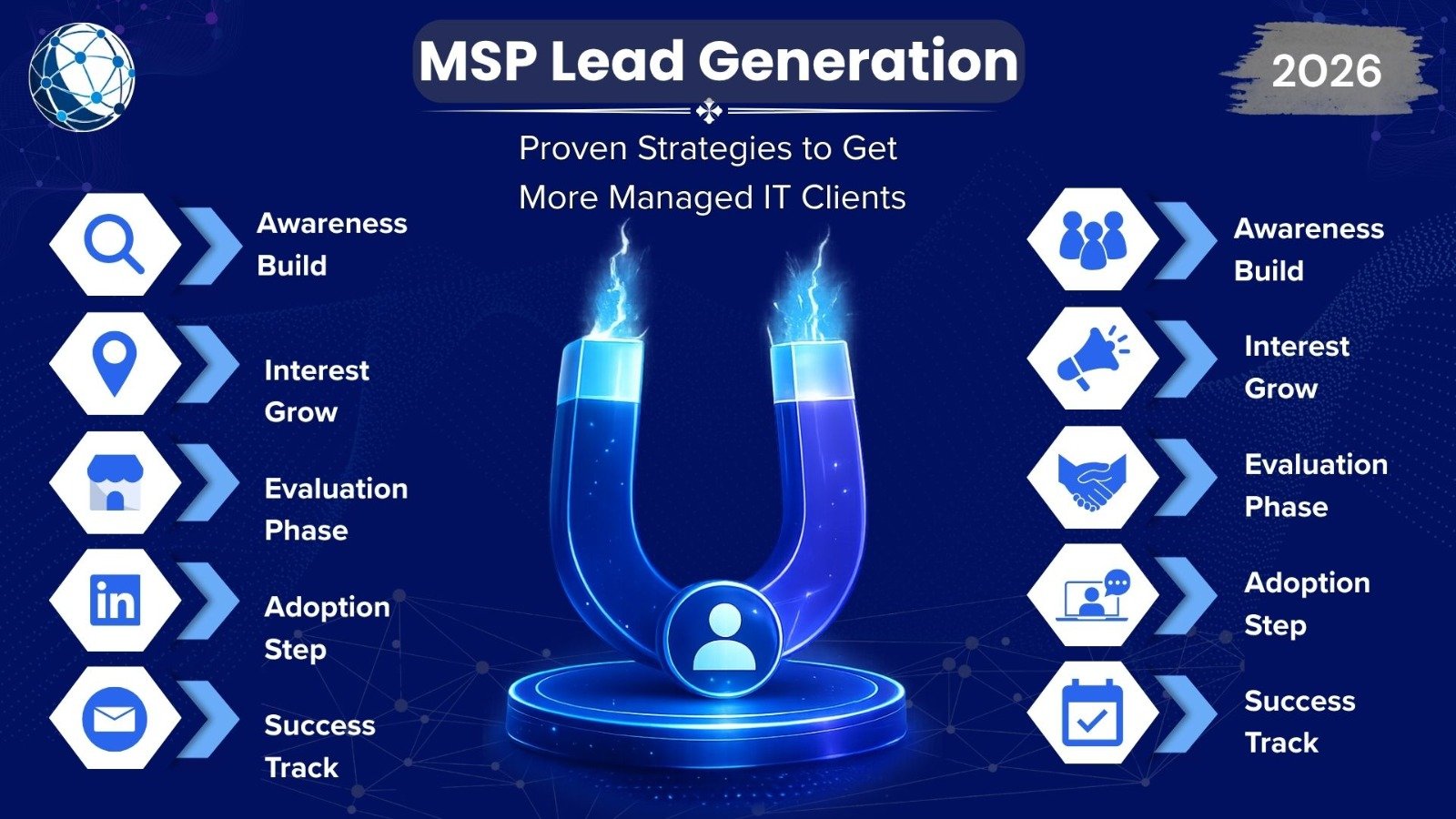
An MSP sales funnel is the structured journey a prospect takes from first discovering your firm to signing a managed services agreement. It has five stages: Awareness, Interest, Consideration, Decision, and Retention. Each requires different activities and different messaging.
Awareness is where it starts. A business owner searches “IT support companies” and finds your website through organic search. Or they see your LinkedIn content. Or an accountant mentions your name. Awareness comes from SEO, content marketing, paid advertising, and the relationships you’ve built. The job at this stage is simply to be found.
Interest develops when a prospect takes a deliberate action. They subscribe to your newsletter, download a cybersecurity checklist, request a free network assessment, or reply to a cold email. Now you have a real contact, and nurturing matters enormously from here. Regular, educational email communication keeps your MSP visible and builds credibility during the long gap between a prospect’s first engagement and when they’re actually ready to buy. Lead nurturing is genuinely the difference between a lost lead and a signed contract for a lot of MSP opportunities.
Decision is the contract stage. Clear service-level agreements, transparent pricing, and an onboarding process that doesn’t feel like a bureaucratic nightmare all reduce friction. A lot of MSP deals don’t die because the prospect chose a competitor; they die because the buying process was confusing or slow and the prospect’s urgency faded.
Map your current process to these five stages and figure out where prospects are dropping off. That’s the friction point to fix first.
How to Qualify MSP Leads
Not every lead deserves the same level of sales attention, and chasing unqualified prospects is one of the most expensive mistakes a growing MSP can make. The BANT framework (Budget, Authority, Need, Timeline) gives you a practical structure for making those calls.
Budget is about fit, not gatekeeping. A five-person company looking for $200/month in basic support is a legitimate prospect for some MSPs; it’s a distraction for others. Know what minimum engagement size makes a client profitable for your model, and qualify accordingly. Frame budget conversations around “what level of IT coverage are you looking to put in place” rather than asking directly what they’re willing to spend. The answer will tell you what you need to know.
Authority is about not wasting weeks building a relationship with someone who can’t say yes. In small and mid-sized businesses, the decision-maker for IT services is usually the owner, CFO, or COO. Early in any conversation, it’s worth asking who else would be involved in evaluating something like this. That single question tells you whether you’re talking to the right person.
Need is the accelerant. A prospect who just had a ransomware scare, whose IT person just put in notice, who’s staring down a HIPAA audit, or who is planning a cloud migration has active urgency that dramatically shortens the sales cycle. Prospects without a clear, pressing need aren’t bad prospects; they’re just longer-term investments that need nurturing rather than immediate sales attention.
Timeline is about resource allocation. “We’re thinking about switching someday” and “our current contract expires in 90 days” require completely different responses. Prioritize near-term timelines for active sales effort while keeping longer-horizon prospects in an email nurture sequence that keeps you present until their situation changes.
Best MSP Lead Generation Tools
The right tools don’t generate leads by themselves, but they make every part of the process faster, more measurable, and easier to scale.
HubSpot is a popular CRM for MSPs because it combines contact management, lead tracking, email automation, and reporting in one platform. Its free plan is a great starting point for small MSPs looking to organize and grow their sales pipeline.
Salesforce makes more sense for larger MSPs with complex sales processes, multiple sales reps, and the need for deep integration with PSA platforms like ConnectWise or Autotask. It’s more powerful and considerably more work to configure and maintain.
LinkedIn Sales Navigator deserves its own mention because it’s not just a prospecting tool; it’s an intelligence platform. Job change alerts, company growth signals, and content engagement notifications all create natural, timely reasons to reach out to a prospect without manufacturing pretexts.
For SEO, Ahrefs and SEMrush are the two platforms worth knowing. SEMrush has stronger advertising intelligence and competitor ad analysis; Ahrefs is generally preferred for backlink research and content gap analysis. Either one will show you exactly where your organic search opportunities lie and how your competitors are winning rankings you’re not.
Google Analytics shows where your website traffic comes from, while Microsoft Clarity reveals how visitors interact with your pages. Together, they help MSPs identify and fix conversion issues more effectively.
For contact data and outbound prospecting, Apollo.io and ZoomInfo are the two tools most MSPs are using. Both give you verified business contact information for decision-makers at target companies. The data quality matters enormously; bad lists destroy email deliverability and waste sales team time.
Common MSP Lead Generation Mistakes
The most common mistake is treating referrals as a strategy rather than a supplement. Referral leads are excellent, but referral volume is unpredictable and structurally insufficient for long-term growth. An MSP whose pipeline is 80% referral-dependent is one slow quarter away from a revenue problem.
A close second is trying to serve everyone. “We support businesses of all sizes in the greater area” sounds inclusive; what it actually communicates is nothing in particular to anyone in particular. The MSPs that own specific verticals, accounting firms, dental practices, law offices, and financial services companies generate more leads and close them faster than generalists because their messaging is specific to real problems those industries face. An MSP that tries to serve every industry ends up owning none of them.
Website neglect is another one that’s more expensive than it looks. Most MSP websites are digital brochures: a list of services, a page about the team, a contact form buried at the bottom. A visitor who arrives from a paid ad, finds no compelling offer and no social proof, and has no easy way to take a next step will leave within seconds, and you’ve paid for that click. Your website is a conversion tool; treat it like one.
Finally, giving up on outbound too early is a real problem. Research across B2B sales consistently shows that most decisions require five to eight touchpoints before a prospect engages. MSPs who send one cold email and call it a day are leaving most of their potential meetings on the table.
MSP Lead Generation Case Study
A 15-person MSP in Columbus, Ohio had been sitting at $85,000 MRR for 18 months. Their growth had stalled. About 80% of new clients came from referrals and they had no systematic outbound or inbound program to speak of.
They decided to stop being generalists. After looking at their best existing clients, they identified two verticals worth going after: accounting firms and dental practices. Both industries have real compliance requirements (data security regulations for accountants, HIPAA for dental) and neither was well-served by generic IT messaging.
Over the following six months, they built vertical-specific landing pages for each audience, published eight compliance-focused blog posts, and fully optimized their Google Business Profile. Simultaneously, they launched a LinkedIn prospecting campaign targeting CFOs and practice owners at firms with 10 to 40 employees within a 50-mile radius. A cold email sequence positioned them around “Compliance-Ready IT.” They also formalized a referral program with a $500 service credit for any client referral that resulted in a signed agreement.
At the 12-month mark: organic traffic was up 220%, inbound content and GBP had generated 34 discovery calls, LinkedIn and cold email had produced 18, and the referral program had added 9 more. They’d signed 22 new clients, and MRR had grown from $85,000 to $119,000, a 40% increase. Average cost per new client across all channels was $1,240.
The takeaway isn’t the specific tactics; it’s what vertical focus did to all of them simultaneously. The content worked better because it was specific. The outreach worked better because the message was relevant. The referrals came more easily because existing clients could describe exactly who would benefit. Everything compounded because it all pointed in the same direction.
Future of MSP Lead Generation
The next three to five years are going to change the tools and scale of MSP lead generation more than the previous decade did. The fundamentals of trust, relevance, and timing won’t change, but the capabilities available to execute on them will.
AI and automation are already transforming outbound prospecting in practical ways. AI writing tools generate personalized cold email copy at scale in ways that weren’t feasible two years ago. AI-powered website chatbots qualify visitors in real time, capturing discovery information before any human interaction takes place. Workflow automation in HubSpot and similar platforms eliminates the manual follow-up delays that cause warm leads to go cold while your team is focused elsewhere.
Intent data is probably the most significant near-term shift. Platforms like Bombora track content consumption across thousands of websites and flag companies showing elevated research activity around topics like “managed IT services,“ “cybersecurity solutions,” or “cloud migration.” An MSP with access to that data can prioritize outreach toward accounts that are actively evaluating vendors right now, before those prospects fill out a contact form anywhere. It turns lead generation from reactive to proactive in a way that fundamentally changes the economics.
Predictive analytics will increasingly help MSPs identify which pipeline prospects are most likely to close and which existing clients are showing early churn signals. That kind of intelligence lets sales and account management teams direct their time where it matters most.
Need More Qualified MSP Leads?
Building the strategy is one challenge. Having the right data to execute it is another. A lot of MSPs put solid outreach programs in place and still struggle to produce results because the contact data they’re working from is outdated, inaccurate, or too broadly targeted to produce meaningful response rates.
DemandTab gives managed service providers access to verified MSP contact databases and decision-maker intelligence built specifically for IT services firms. Whether you’re constructing a prospecting list for cold email, identifying CFOs and operations directors at companies in your target verticals, or enriching your CRM with accurate contact records, DemandTab gives your sales team the data foundation it needs to execute without wasting cycles on dead ends.
The quality of your underlying data shapes the quality of everything built on top of it. If your lead generation efforts aren’t producing the results they should, that’s often the place to look first.
Frequently Asked Questions
What is MSP lead generation?
MSP lead generation is the process of attracting, engaging, and converting businesses into qualified sales opportunities for managed IT services. It includes inbound marketing, outbound prospecting, referral programs, paid advertising, and partnership development, with the goal of building a consistent pipeline of potential clients who need IT support, cybersecurity, cloud services, or network management.
How do MSPs get clients?
MSPs get clients through a combination of SEO, Google Business Profile optimization, LinkedIn prospecting, cold email outreach, referral programs, strategic partnerships, paid advertising, webinars, and industry events. The most effective MSPs use multiple channels at the same time rather than relying on any single source.
What are MSP sales leads?
MSP sales leads are businesses that have expressed interest in or shown a likely need for managed IT services. A qualified MSP lead typically includes a verified decision-maker, a known IT pain point or compliance requirement, a sufficient budget, and a defined timeline for making a purchasing decision.
How much should MSPs spend on marketing?
Industry benchmarks suggest MSPs invest between 5% and 10% of gross revenue on marketing, depending on stage and growth goals. Early-stage MSPs pushing for rapid growth often invest at the higher end. Established firms with strong referral networks can often operate effectively at 5% or below.
Is SEO effective for MSP lead generation?
Yes, and it’s one of the highest-ROI channels available to MSPs over time. SEO captures buyers who are actively searching for IT services and has a lower long-term cost per lead than paid advertising once organic rankings are established. The trade-off is time: meaningful organic results typically take 6 to 12 months to develop.
What tools help MSPs generate leads?
The core stack for most MSPs includes HubSpot or Salesforce for CRM and pipeline management, LinkedIn Sales Navigator for prospect research and outreach, Ahrefs or SEMrush for SEO intelligence, Google Analytics and Microsoft Clarity for website performance analysis, and Apollo.io or ZoomInfo for contact data and outbound prospecting.
How can MSPs find decision-makers?
LinkedIn Sales Navigator is the most direct tool for identifying decision-makers by title, company size, industry, and geography. Contact data platforms like Apollo.io, ZoomInfo, and DemandTab provide verified contact records for decision-makers at specific target companies.
What is the fastest way to generate MSP leads?
Paid advertising, specifically Google Ads targeting high-intent local keywords, can produce inquiries within 48 hours of campaign launch. LinkedIn Ads and targeted cold email with a strong offer (such as a free network assessment or cybersecurity audit) are also fast-activation channels that can produce meetings within days.
What is an MSP sales funnel?
An MSP sales funnel is the structured journey a prospect takes from first discovering your services to signing a managed services agreement. It runs through five stages: awareness (prospect finds you), interest (prospect engages), consideration (prospect evaluates you alongside competitors), decision (prospect signs), and retention (client stays and grows). Each stage requires different sales and marketing activities.
Are MSP lead databases worth it?
When the data is accurate, current, and targeted to your ideal client profile, yes. Outdated or broadly scraped databases waste sales time and damage email sender reputation. Verified, industry-specific databases like those available through DemandTab produce meaningfully higher response rates because the contacts are real, current, and relevant to what you’re selling.